

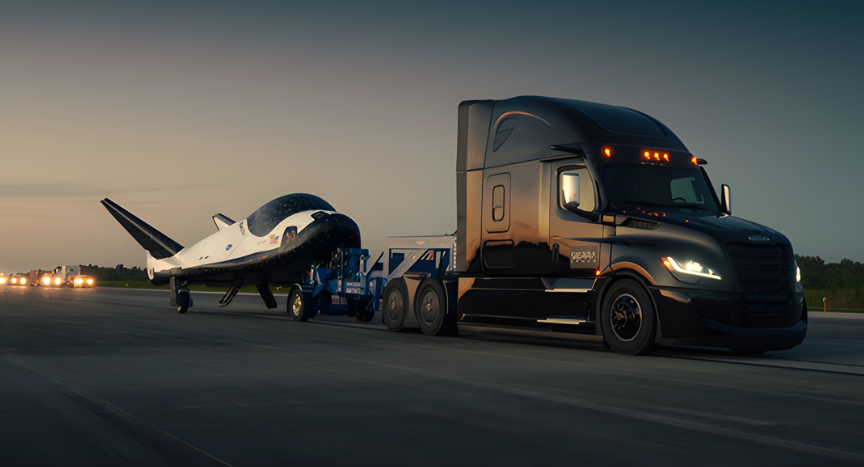
Most drivers haul freight that stays on the ground. A crew at Kennedy Space Center recently hauled something built to leave it. Freightliner Trucks teamed up with Sierra Space to help move and test the Dream Chaser spaceplane, a vehicle designed to carry cargo to and from low Earth orbit. The work involved towing the spacecraft with a fifth-generation Freightliner Cascadia to confirm how the spaceplane handles a high-speed landing rollout.
The test took place on the fifteen-thousand-foot runway at the Launch and Landing Facility. Before the tow work began, DTNA product validation engineer Nate Fleming hauled Dream Chaser roughly ten miles from NASA’s Space Systems Processing Facility. The careful move positioned the vehicle for the runway portion of the project.
“A lot was riding on this testing,” Fleming said. “Sierra Space trusted me to haul Dream Chaser, and trusted the Cascadia to carry it safely.”
The job required steady acceleration and smooth speed control. Sierra Space set up the test trailer and relied on a standard Cascadia sleeper with a seventy-two-inch raised roof. The truck ran Sierra Space’s programmed test speeds and reached up to seventy miles per hour. The powertrain used a Detroit DD15 engine paired with a DT12 automated manual transmission and Detroit axles to deliver consistent traction across the full runway.
Dream Chaser is built for vertical launch inside a rocket fairing, followed by wing deployment in orbit and a controlled return to Earth. Its landing gear setup includes tandem rear wheels and a single reinforced skid plate to reduce weight and simplify the design. Sierra Space used the tow test to confirm how the landing system behaves during a high-speed rollout.
“Dream Chaser is redefining how cargo moves in space, and that shared spirit of innovation made this partnership a natural fit,” said David Carson, senior vice president of sales and marketing at DTNA.
Sierra Space notes that Dream Chaser’s ability to land on a runway places returned cargo closer to processing teams and distribution points. The tow test supports that mission by proving the vehicle can handle repeated landings under realistic conditions.
“This test is about proving we can land safely, reliably, and repeatedly,” said Klint Combs, vice president of test engineering at Sierra Space.
For truck drivers, the project highlights how a dependable tractor and a skilled operator can support work far beyond everyday freight. In this case, a Cascadia helped push a new spaceplane one step closer to routine missions.
Source: Trucking Info