

The Midwest has long played a central role in over-the-road trucking, and that role continues today. For drivers entering long-haul work or transitioning from local or regional routes, the region offers practical advantages rooted in geography, freight flow, and infrastructure.
This is not about rankings or trends. It is about how freight actually moves across the United States and why the middle of the country remains essential to that movement. When those factors are understood, it becomes clear why so many long-haul careers still begin in the Midwest.
Central Geography Supports Long-Haul Routing
The Midwest sits at the center of the national freight network. States such as Illinois, Indiana, Ohio, Missouri, Iowa, and Wisconsin connect eastern markets, southern distribution centers, and western manufacturing hubs through direct interstate routes.
For long-haul drivers, this positioning increases access to multi-state runs instead of short regional loops. Freight moving through the Midwest is often traveling between regions rather than terminating locally, which supports longer routes and more consistent mileage.
According to the Bureau of Transportation Statistics, a large share of interstate truck freight passes through Midwestern corridors before being redistributed nationwide. That steady movement supports predictable long-haul operations.
Freight Redistribution Keeps Miles Consistent
The Midwest functions as a redistribution center for agricultural goods, manufactured products, retail inventory, and intermodal freight. Loads arriving from ports, rail terminals, and factories are consolidated and sent back out across the country.
Logistics hubs in cities such as Chicago, Columbus, Indianapolis, Kansas City, and St. Louis play a key role in balancing inbound and outbound freight. Balanced freight flow matters to drivers because it reduces the likelihood of empty miles and extended waiting periods.
The American Trucking Associations has consistently shown that regions with balanced freight movement experience stronger load availability. For long-haul drivers, that balance helps maintain steady weekly mileage.
Interstate Infrastructure Is Built for OTR Driving
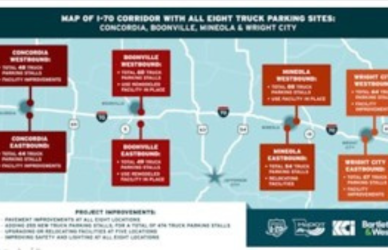
The Midwest’s interstate system was designed to support commercial transportation. Major corridors, including I-80, I-70, I-90, I-94, and I-55, intersect throughout the region, allowing drivers to move efficiently between markets.
Compared to dense coastal areas, Midwestern routes generally involve fewer bottlenecks and more predictable transit times. Fuel stops, rest areas, and service facilities are widely available, which simplifies trip planning for drivers new to over-the-road work.
Seasonal weather is a factor in parts of the Midwest, but carriers operating in the region account for it when planning routes and schedules. For new long-haul drivers, that predictability is easier to manage than sudden congestion or complex urban routing.
Carrier Presence Expands Job Access
Many national and mid-sized carriers operate terminals, drop yards, and training facilities across the Midwest. A central location allows fleets to dispatch drivers in all directions without losing productive miles.
Data from the Bureau of Labor Statistics shows consistently high trucking employment across Midwestern states. Higher employment density often means more job options, more route variety, and greater flexibility for drivers building experience.
For drivers entering long-haul roles, this carrier concentration reduces the need to relocate and increases access to different equipment types and operating models.
The Midwest Supports Smooth OTR Transitions
Drivers moving from local or regional positions into long-haul work often find the Midwest to be a practical transition point. Many regional driving jobs in the area already operate within national freight networks tied to manufacturing, agriculture, and distribution.
That familiarity allows drivers to focus on adjusting to long-haul schedules, log management, and trip planning rather than learning an entirely new operating environment at the same time.
Carriers also recognize this advantage. Training and transition programs frequently use Midwestern routes because they offer consistent miles without excessive congestion or overly complex delivery conditions.
Cost of Living Helps Early Career Stability
While long-haul pay is not determined by home location, the cost of living still affects financial stability. Many Midwestern areas have lower housing, insurance, and daily living costs than coastal regions.
For drivers early in their OTR careers, especially those paying down CDL training costs or adapting to mileage-based pay, a lower cost base can reduce financial pressure during the first year.
This allows drivers to focus on gaining experience and maintaining consistency before pursuing specialized freight or endorsements later on.
What This Means for Drivers Considering Long-Haul Work
The Midwest remains a launch point for long-haul trucking because the structure of the freight network continues to support it. Central geography, balanced freight flow, strong infrastructure, and carrier density all contribute to reliable over-the-road opportunities.
For drivers entering OTR roles, the Midwest offers access to steady miles and manageable routes. For drivers transitioning from local or regional work, it provides continuity while building nationwide experience.
The region does not guarantee higher pay or easier work. What it offers is stability and access, which are critical foundations for a long-haul trucking career.
Search truck driver jobs near you on TruckDriversUSA.