


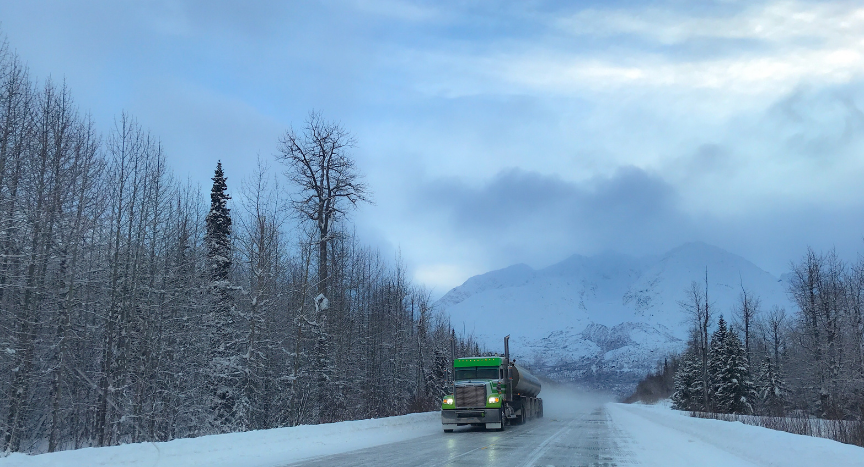
Truck driver pay in Alaska is well above the national median, but a statewide figure only tells part of the story. Earnings vary between Anchorage, Fairbanks, and other parts of the state, while the type of freight, schedule, and employer can create an even wider gap between individual jobs.
The latest available wage data puts the median for heavy and tractor-trailer truck drivers in Alaska at $70,100 per year, or $33.70 per hour. The statewide average is $69,520 annually, giving drivers a useful benchmark before looking more closely at where wages differ.
What Truck Drivers Earn Across Alaska
Alaska’s wage range shows how much earnings can vary within the occupation. Drivers at the 25th percentile earn about $60,500 annually, while the 75th percentile reaches $78,060. At the upper end, the 90th percentile is $90,610.
Those figures should not be treated as starting salaries or guaranteed earnings. They represent drivers working for different employers, at different experience levels, and across multiple types of trucking jobs.
Location adds another layer to that range. Anchorage accounts for a large share of the state’s transportation employment, but its average wage is actually slightly below the statewide figure.
Anchorage Truck Driver Pay
In May 2025, the Anchorage metropolitan area had an estimated 1,620 heavy and tractor-trailer truck driver jobs. Average earnings were $32.48 per hour, equivalent to about $67,560 annually.
Anchorage’s role as a major freight and distribution center creates opportunities involving local deliveries, regional freight, and work supporting industries elsewhere in the state. Individual compensation can still land well above or below the area’s average depending on the assignment and employer.
Heading north to Fairbanks changes the wage picture again, with current estimates showing higher typical earnings.
Fairbanks Truck Driver Pay
Heavy and tractor-trailer truck drivers in the Fairbanks North Star Borough average $34.78 per hour, while the median reaches $36.81. Annualized at a full-time schedule, that median is roughly $76,560 before overtime or other compensation is considered.
The region also serves freight moving throughout Interior Alaska and farther north. Some positions may involve longer distances, different schedules, or operating conditions that are not comparable with a local job based in Anchorage.
Higher wages are not limited to Fairbanks, either. Looking beyond Alaska’s two largest employment centers shows why drivers should compare the location of a job instead of relying solely on the statewide median.
Truck Driver Pay Outside Anchorage and Fairbanks
Alaska’s balance-of-state data shows an average wage of $34.13 per hour for heavy and tractor-trailer truck drivers, with a median of $34.66.
At the upper end, the 90th-percentile wage reaches $48 per hour. That figure does not mean jobs paying that rate are widely available across rural Alaska, but it does show the earning range found outside the state’s largest population centers.
The paycheck also needs to be considered alongside the realities of the position. Distance, time away, housing arrangements, seasonal schedules, and access to services can change the value of an offer considerably, particularly when work is based in a remote location.
Why Some Alaska Trucking Jobs Pay More
Geography is only one factor separating a $60,000 position from one approaching or exceeding $90,000. The work itself can have just as much influence.
Jobs requiring additional qualifications, specialized equipment, difficult operating conditions, or less conventional schedules may carry different compensation than standard freight positions. Alaska also has trucking work connected to oil and gas, mining, construction, freight distribution and other industries that depend on moving equipment and supplies over considerable distances.
Those industries continue to support employment across the state. Alaska’s transportation, warehousing, and utilities sector had 1,200 more jobs in July 2026 than a year earlier, while oil and gas employment increased by 800.
Industry growth does not guarantee higher wages in an individual career, however. Drivers comparing opportunities still need to determine exactly how an advertised salary is earned.
Compare the Pay Structure, Not Just the Salary
A job advertised at $80,000 is not automatically a better offer than one advertised at $70,000. The more useful comparison is what a driver has to work, haul, and give up to reach that number.
Start with the compensation structure. Determine whether the job pays hourly, by the mile, on salary, or through a combination of methods, then find out how overtime, loading, unloading, waiting time and other work are compensated. When an advertisement lists a wide earnings range, ask what separates drivers near the bottom from those consistently reaching the upper end.
Schedule can change the equation just as quickly. Higher annual earnings may come with extended shifts, seasonal work, more time away, or a rotation that does not fit what a driver wants.
Benefits can narrow the gap between two offers as well. Health coverage, retirement contributions, paid time off, and bonuses all have value that will not necessarily appear in the advertised annual salary.
How Alaska Pay Compares with the Rest of the Country
Alaska’s $70,100 median is considerably higher than the national median of $58,640 for heavy and tractor-trailer truck drivers. That puts the state more than $11,000 above the national benchmark.
Cost of living is an important part of that comparison. Housing, groceries, utilities, and other expenses can be higher in parts of Alaska, while costs also vary substantially from one community to another. Alaska does not impose an individual state income tax, which is another difference drivers may want to consider when comparing take-home pay with jobs elsewhere.
For drivers already living in Alaska, the regional wage figures provide a more useful comparison than the national number alone. Someone considering a move to the state has an additional calculation to make because a higher salary does not automatically translate into more disposable income.
Finding the Right Alaska Truck Driving Job
Current wage data shows that Alaska can offer strong earning potential for truck drivers, but the best-paying opportunity on paper is not necessarily the best fit.
A driver comparing positions in Anchorage, Fairbanks, or elsewhere in the state should look at the entire job: base compensation, realistic annual earnings, schedule, freight, benefits, time away, and the conditions attached to the work.
The statewide median provides the benchmark. Understanding what sits behind an individual offer is what determines whether that opportunity actually measures up.
Frequently Asked Questions
How many heavy and tractor-trailer truck drivers work in Alaska?
The latest occupational employment estimates put employment at approximately 3,420 statewide. That figure represents people employed in the occupation rather than everyone in Alaska who holds a commercial driver’s license.
Does Alaska have a state income tax on wages?
No. Alaska does not impose an individual state income tax. Drivers comparing jobs in different states may want to account for that when estimating take-home pay.
Does higher truck driver pay offset Alaska’s cost of living?
Not automatically. Expenses vary considerably by community, particularly between larger population centers and remote areas. A relocation decision should compare expected earnings with housing, food, utilities, and other costs in the specific area where the driver would live.
Are Alaska truck driving jobs available year-round?
Many are, but some transportation needs are affected by construction seasons, resource development, and other industries with changing workloads. Drivers considering a position should confirm whether the advertised earnings are based on steady year-round work or a schedule with seasonal fluctuations.