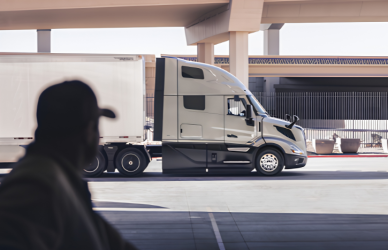



A modern sleeper can provide standing room, a full-size mattress, cabinets, a refrigerator, space for a microwave, a table and heating or cooling that works while the engine is off. That is a considerable departure from the earliest sleeper compartments, where nearly all of the available space was devoted to one thing: a bunk.
The transformation did not happen simply because manufacturers kept making sleepers bigger. Changes in cab design, available interior height, electrical systems, climate control, and the way space was organized gradually allowed the area behind the seats to take on more jobs.
The First Challenge Was Finding Room for a Bed
As long-distance trucking expanded, staying overnight with the truck created an obvious need for sleeping space. Kenworth records selling its first sleeper cab in 1936, during an era when a sleeper was primarily a practical solution for rest between stretches of driving.
Early designs had very little room to spare. The bunk occupied much of the compartment, headroom was limited, and storage or other conveniences had to fit around the space needed to sleep.
Truck design also placed limits on what could be added. For decades, cabovers were widely used in long-haul service because their shorter overall configuration left more allowable length for the trailer under the vehicle-length rules of the time. With the engine beneath the cab and space at a premium, sleeper designers had to make efficient use of relatively compact interiors.
The result was fundamentally different from today’s idea of a sleeper. It was a sleeping compartment first, with everything else secondary.
Raising the Roof Changed More Than Headroom
Making sleepers longer added floor space, but increasing their height changed how that space could actually be used.
Kenworth’s 1976 Aerodyne became an important example of that shift. Its raised roof provided approximately seven feet of interior headroom, making it possible to stand upright rather than treating the area behind the seats primarily as a place to crawl into a bunk.
Once designers gained vertical space, the interior could expand upward instead of relying only on additional length. Taller cabinets became practical, belongings could be stored away from the bed, and the area above and around the bunk became useful space.
Raised roofs eventually became familiar across long-haul equipment. Freightliner introduced a 70-inch raised-roof sleeper in 1992, and increasingly large configurations helped establish the tall sleeper profile now associated with many highway tractors.
Integrating the Cab Made the Space More Usable
Size was only part of the equation. Older sleepers could be separate boxes or compartments attached behind the cab, creating a noticeable division between the driving area and sleeping area.
Manufacturers gradually moved toward designs that treated both areas as one interior. Volvo introduced a fully integrated sleeper compartment in 1983, while Peterbilt followed with its Unibilt system in 1993.
Removing more of the physical separation made movement between the seats and sleeper easier, but it also gave designers greater flexibility in arranging the interior. Instead of designing a cab and then finding somewhere behind it for a bed, the entire space could be planned around driving, storage, rest and time spent parked.
That opened the door to features such as convertible tables and seating. Volvo introduced a workstation dinette in 1997, allowing part of the sleeper to change functions rather than permanently dedicating the same floor space to one use.
Electrical Power Expanded What Could Go Inside
A larger interior is not especially useful for appliances if the truck cannot conveniently power them. As sleeper electrical systems became more capable, manufacturers could design around equipment that previously would have required more extensive aftermarket installation.
Today’s factory sleepers can provide dedicated locations and electrical connections for refrigerators, microwaves, televisions, and other equipment. A current Kenworth T680 76-inch sleeper, for example, can be configured with a refrigerator, microwave space, television provision and a rotating table.
The change also affected storage. Peterbilt’s 80-inch UltraLoft uses its eight-foot interior height to provide 70 cubic feet of storage, showing how modern sleeper design makes use of the area above, below and alongside the traditional bunk.
That development is easy to overlook. The modern sleeper did not just gain more amenities. Its cabinets, outlets, appliance locations, and storage compartments increasingly began being planned around those amenities from the factory.
Parked Climate Control Changed the Sleeper Again
Temperature was another longstanding limitation. Keeping the cab comfortable while parked traditionally meant relying heavily on the truck’s engine for heating or air conditioning.
Auxiliary power units, bunk heaters, and later battery-powered HVAC systems began separating sleeper comfort from continuous engine operation. That became increasingly valuable as fuel costs and anti-idling restrictions made hours of engine idling less desirable.
Modern factory systems can now maintain the sleeper environment with the engine shut down. Volvo’s current VNL, for example, offers a battery-powered parking cooler designed to provide up to eight hours of cooling, along with separate heating options for cold weather.
That independence changed the sleeper in a way additional cabinets could not. Heating and cooling became functions of the living area itself rather than something available only while the main engine was running.
Modern Sleepers Make Space Serve More Than One Purpose
There are still hard limits on how much room can be devoted to living space on a working tractor. That has made efficient use of the available interior just as important as overall sleeper size.
Beds can lift to expose storage. Tables can rotate or convert. Cabinets use vertical areas that once would have been empty. Upper bunks can fold away when they are not needed, while refrigerators and other appliances are fitted into cabinetry instead of taking up open floor space.
Current factory sleepers illustrate just how different that approach is from the original bunk compartment. Kenworth offers a 76-inch configuration with a full-size mattress and multiple storage and appliance options, while Peterbilt’s 80-inch UltraLoft combines standing height, large mattresses, extensive storage and space for everyday appliances.
Those features are not simply a collection of comforts added over time. They show how the design objective changed. The earliest sleeper needed to fit a person lying down. A modern sleeper has to make limited space useful while that person is awake too.
From Somewhere to Sleep to Space for Life on the Road
Nearly every major step in sleeper development solved a different limitation. Early compartments provided the bunk. Longer and taller designs created usable room around it. Integrated cabs opened the interior, improved electrical systems supported appliances, and independent climate control made the space more functional while parked.
That progression explains why comparing an early sleeper with a current model involves more than measuring the distance behind the seats. The purpose of the space changed along with its dimensions.
The bunk never disappeared, but the rest of the sleeper grew around it.
FAQ
When did sleeper cabs first appear on American trucks?
Sleeper arrangements existed in several forms during trucking’s early decades, including aftermarket and bodybuilder installations. Kenworth records selling its first factory sleeper cab in 1936.
Why did early sleeper compartments have so little space?
Vehicle dimensions and truck design placed tight limits on available room, while the primary purpose of the compartment was providing a place to sleep. Cabover configurations also became common during an era when overall vehicle-length restrictions encouraged manufacturers to devote as much allowable length as possible to cargo.
What made raised-roof sleepers important?
Additional height created usable vertical space rather than simply increasing the footprint of the sleeper. It allowed occupants to stand and gave manufacturers more room for cabinets, storage, and other interior features.
When did sleepers begin becoming part of the cab instead of separate compartments?
The transition happened gradually. Volvo introduced a fully integrated sleeper compartment in 1983, and Peterbilt introduced its Unibilt cab-and-sleeper system in 1993.
How large are factory sleepers today?
Dimensions vary considerably by model. Current examples include Kenworth’s 76-inch sleeper and Peterbilt’s 80-inch UltraLoft, the latter offering eight feet of interior height and 70 cubic feet of storage.
Can a modern sleeper stay cool without the engine running?
Some current trucks can use battery-powered parking HVAC systems, while other configurations rely on auxiliary power units or separate heating equipment. Available systems vary by truck and specification.