
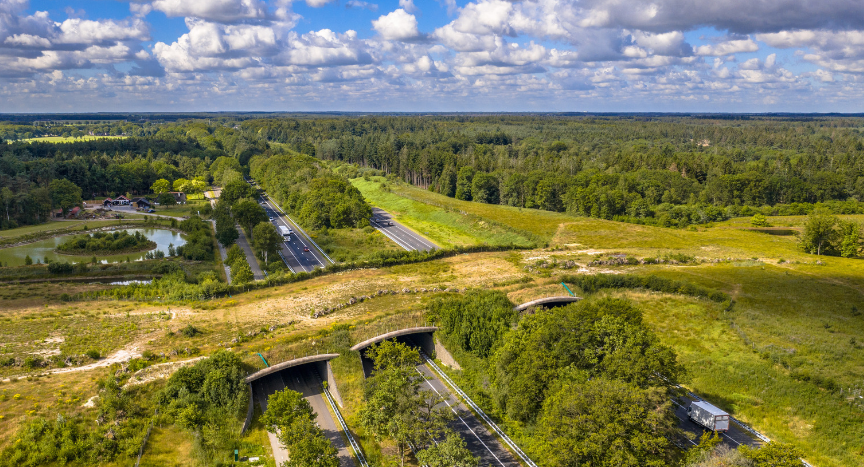
A stretch of highway can look completely ordinary to the people traveling through it while cutting directly across a route animals have followed for generations. Deer and elk still move between seasonal habitats, and highways built through those areas can leave them with few safe ways to reach the other side. Transportation agencies have been addressing that problem with structures designed specifically for wildlife, including some that look more like landscaped bridges than part of a highway.
These crossings are already in use across the United States, and years of monitoring have produced results that go well beyond photographs of animals passing through them. In some locations, researchers have documented tens of thousands of successful crossings alongside substantial reductions in collisions. The findings have helped make wildlife passages a more established consideration in highway planning.
A Highway Doesn’t Erase an Animal’s Migration Route
Wildlife crossings are generally built where roads interrupt established movement corridors. Animals use these routes to reach seasonal feeding areas, breeding grounds, and other habitats, sometimes traveling along the same paths year after year. When a highway divides those areas, the animals may continue crossing at road level, regardless of how much traffic is passing through.
The challenge for transportation agencies is identifying where a dedicated passage will do the most good. Collision records provide part of the picture, but they don’t necessarily reveal every location where animals are attempting to cross. Wildlife biologists also study migration patterns, habitat connections, and the surrounding terrain before engineers determine where a structure can be built.
Arizona’s State Route 260 offers an example of this work. Researchers examined elk and deer movements in the region east of Payson, using their findings to help identify locations for wildlife passages and associated highway improvements. The Arizona Department of Transportation has continued using wildlife movement research to inform projects elsewhere in the state.
Arizona Department of Transportation: Wildlife Connectivity
Colorado’s Highway 9 Project Provides Years of Evidence
One of the country’s best-documented wildlife crossing projects runs along 10.5 miles of Colorado State Highway 9 near Kremmling, where mule deer migrate through the surrounding landscape.
Completed in 2016, the project brought together two overpasses, five underpasses, and fencing along the highway. The fencing was an important part of the work because it helped direct animals toward the crossings instead of leaving them to enter traffic wherever they approached the road.
Researchers recorded 112,678 successful mule deer passages through the seven structures between November 2015 and April 2020. Elk, moose, pronghorn, black bears, and bobcats were among the other animals documented using the corridor.
The safety findings were equally notable. The project’s final monitoring report documented a 92% reduction in wildlife-vehicle crashes and a 90% reduction in recorded wildlife carcasses. Those results reflect the combined crossing and fencing system, not simply the presence of two bridges.
The study also provided evidence that animals were continuing to move between habitats on opposite sides of the highway. That matters because a project that prevents animals from reaching the roadway but leaves them unable to cross can create another problem. Colorado’s results showed that safer traffic conditions and continued wildlife movement could be achieved together.
State Highway 9 Wildlife Crossings Monitoring Report
Arizona’s Crossings Serve Very Different Animals
The appearance of a wildlife crossing depends heavily on the animals expected to use it. A passage suited to bighorn sheep in an open desert landscape may look quite different from one intended for elk in a forested mountain corridor.
Near Hoover Dam, three wildlife overpasses along U.S. Route 93 were built for desert bighorn sheep. Monitoring by the Arizona Game and Fish Department documented more than 4,300 sheep crossings over two years, demonstrating that the animals were using the bridges to move through the area.
The improvements along State Route 260 addressed a different setting. Elk and deer were a major focus, although researchers eventually recorded a much broader range of wildlife using the underpasses. According to ADOT, six structures accommodated more than 15,000 passages by 16 animal species during seven years of monitoring.
Fencing improvements linking three existing crossings were also associated with a 98% reduction in elk-vehicle collisions over six years.
The Arizona projects help explain why there isn’t one standard design that works everywhere. An overpass can provide a relatively open crossing with natural ground cover, while an underpass makes use of the space beneath a roadway. Smaller passages may also be built or adapted for amphibians, reptiles, and other animals that would not need a full-size bridge.
Arizona DOT: Wildlife Crossings and Environmental Leadership
Wildlife Crossings Are Becoming Part of Interstate Improvements
These projects aren’t limited to smaller highways. In 2024, Colorado completed a wildlife underpass beneath Interstate 70 between Genesee and Lookout Mountain, west of Denver. The $10.4 million project addressed a section of I-70 that had recorded the highest number of wildlife-vehicle collisions east of the Eisenhower-Johnson Memorial Tunnel.
Building the passage required more than digging a tunnel. Crews constructed new bridge structures to carry interstate traffic above the crossing, then added approximately two miles of fencing and wildlife escape ramps along the corridor. The underpass was designed primarily for elk and mule deer, although other animals are expected to use it.
The Colorado Department of Transportation projected that the completed improvements could reduce wildlife-vehicle collisions by as much as 90%. That was an anticipated benefit when the project opened, not a measured result, and it should be distinguished from the reductions already documented on Highway 9.
Colorado DOT: I-70 Genesee Wildlife Underpass
What the Research Tells Transportation Agencies
A successful crossing needs to do two things: keep animals away from moving vehicles and allow them to reach habitat on the other side. Those goals aren’t necessarily achieved by the same structure, which is why wildlife fencing, passage design, and location all receive attention during planning.
Monitoring can also reveal problems that weren’t obvious when construction ended. Colorado’s Highway 9 study, for instance, identified opportunities to improve escape ramps and wildlife guards. Researchers also recommended extending mitigation farther south, where collisions and animal movements at road level were still occurring beyond the fenced corridor.
Results from one location cannot simply be applied to every highway. The animals involved, surrounding terrain, traffic conditions, and placement of the crossings all influence their effectiveness. Still, the findings from completed projects have given highway agencies practical evidence to use when planning future improvements.
For professional drivers traveling these routes, a wildlife crossing may be easy to miss. An overpass can resemble a landscaped embankment, and an underpass may be hidden beneath the roadway. Their purpose becomes clearer in the monitoring results, which show that major transportation routes and established wildlife corridors do not always have to be in conflict.
Frequently Asked Questions
Are wildlife crossings only built in areas with large animals?
No. Although projects for deer, elk, and bighorn sheep receive considerable attention, crossings can also accommodate smaller mammals, reptiles, and amphibians. Some highway improvements include smaller culverts or adapted drainage structures for these species.
Who pays for wildlife crossing construction?
Funding varies by project and may include federal transportation grants, state transportation budgets, and contributions from conservation partners. Wildlife crossings can also be incorporated into larger highway construction programs.
Do wildlife crossings require maintenance after construction?
Yes. Fencing, vegetation, drainage, and the crossing structures themselves may require upkeep. Agencies also need to address damaged fencing or blocked passages that could prevent animals from using the intended route.
Can wildlife crossings be added to existing highways?
Yes. The I-70 Genesee project is an example of a wildlife passage added beneath an operating interstate. Other projects adapt existing bridges or culverts when their locations and dimensions are suitable.
Are wildlife crossings open to pedestrians or recreational vehicles?
Wildlife-only crossings are designed for animal movement rather than public access. Their purpose and permitted uses differ from recreational trails or ordinary highway overpasses, so a landscaped wildlife bridge should not be treated as a public walkway.
The TDUSA editorial team creates practical, driver-focused content covering trucking news, industry updates, safety, regulations, and career information for professional truck drivers across the United States. Each article is built to reflect real-world experience, industry developments, and information drivers can use on and off the road.
Last Updated: October 26, 2026