

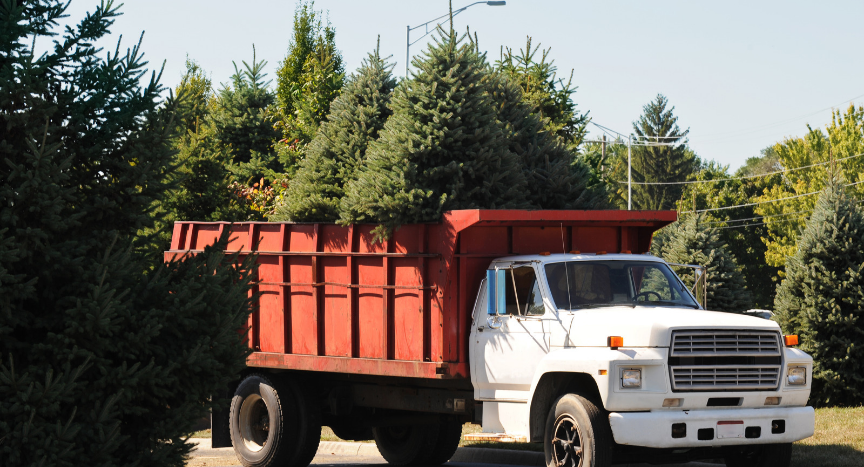
Christmas tree farms have only a few weeks to move much of their annual harvest, creating a concentrated stretch of freight activity each November. For truck drivers hauling these loads, the work can involve remote farm pickups, trailers packed with hundreds of bundled trees, and delivery arrangements that differ from conventional truckload freight.
The busiest growing regions include Oregon and North Carolina, where harvesting and transportation must stay closely coordinated to get trees to retailers before the holiday selling season. Some of the more unusual aspects of the job begin well before a truck arrives at the farm.
Getting Christmas Trees From the Fields to the Trailer
Christmas tree harvesting is labor-intensive, particularly on farms where trees grow across steep or uneven terrain. After cutting, crews gather the trees, compress their branches into protective netting, and move them to collection areas for sorting and loading.
In parts of Oregon, helicopters help with that process. Crews bundle freshly cut trees together so pilots can lift them from the fields and carry them to staging areas. During some operations, helicopters collect bundles at intervals of roughly 30 seconds, allowing growers to move large quantities of trees without sending ground equipment across difficult terrain.
The use of helicopters is one of the more distinctive features of the harvest, but it also serves a practical purpose. Bringing trees to central collection areas allows farms to organize shipments before trucks arrive, rather than requiring drivers to reach individual growing sites.
Once the trees are sorted and prepared for shipment, the next challenge is fitting as many as possible into each trailer without damaging the branches.
Why Loading Can Take More Coordination Than Expected
Unlike palletized freight, Christmas trees are often loaded individually. The Ashe County Christmas Tree Association reports that many North Carolina growers stack bundled trees by hand, although some operations use pallets and forklifts.
A full-size tractor-trailer generally carries approximately 600 to 800 trees, depending on their size. Because the trees vary in shape and dimensions, the loading process requires careful stacking to make use of the available space.
The farm itself can also influence how a pickup is handled. Larger growers may have established loading yards, while smaller operations sometimes use temporary staging areas with limited room for maneuvering. Freight industry accounts have described mountain loading locations where another tractor equipped with chains was needed to help trucks return to the road.
Those conditions aren’t representative of every Christmas tree shipment, but they illustrate why pickup arrangements can vary considerably between farms. After loading, the next decision involves how to protect the trees during transportation, particularly when the destination is several days away.
Why Some Christmas Trees Travel in Reefers and Others Don’t
Freshly cut Christmas trees continue losing moisture after harvest, making transportation conditions an important part of maintaining their appearance before retail sale.
The equipment used depends on the distance and the grower’s preferences. DAT Freight & Analytics reports that shorter shipments from Oregon to California often move in dry vans, while longer trips to the Midwest and East Coast may use refrigerated trailers to limit exposure to temperature extremes.
Refrigeration is not universally preferred. Some shippers are concerned that circulating air can contribute to drying, while the refrigeration unit and necessary airflow space can reduce the trailer’s usable capacity. As a result, different growers may use different methods even when shipping similar products.
One documented Oregon shipping operation used another approach for deliveries to Southern California, blowing approximately a ton of ice over the trees after they were loaded. The ice provided an alternative means of temperature management without relying on continuous mechanical refrigeration.
These differences make Christmas tree freight less standardized than its appearance might suggest. The equipment and handling instructions are closely tied to the destination, and those destinations also determine when shipments need to leave the farm.
The Shipping Rush Starts Before Most People Buy Their Trees
Although Christmas trees are sold throughout the holiday season, the transportation schedule begins much earlier. Growers must account for travel time, retail delivery schedules, and the limited period available to harvest and ship their inventory.
Long-distance orders generally move first, followed by shipments serving markets closer to the growing regions. In Oregon, this creates an early November shipping period that intensifies as Thanksgiving approaches.
The timing overlaps with other agricultural freight moving out of the Pacific Northwest. Apples, pears, and additional fall commodities are still competing for available equipment, while Christmas tree shipments add a temporary increase in demand for dry vans and refrigerated trailers.
DAT has documented how this seasonal activity affects regional freight markets, including higher spot rates during the busiest shipping periods. At major operations, peak shipping days can involve dozens of outbound truckloads.
For drivers and carriers, the opportunity is concentrated into a relatively short period. Unlike freight that moves consistently throughout the year, Christmas tree shipments are tied to a deadline that cannot be extended simply because transportation capacity is limited.
That deadline becomes especially important once the trees leave the growing region and begin moving toward retail destinations.
Delivery Doesn’t Always End at a Distribution Center
Some Christmas tree loads are delivered to large distribution facilities, but others move directly to retail locations. Depending on the customer, a shipment may involve several stops before the trailer is empty.
This can introduce different unloading arrangements from those found at conventional freight facilities. A retail lot may not have the same equipment or receiving space as a warehouse, and the time required to complete deliveries can vary with the number of stops.
The trees also need to arrive early enough for retailers to sell them while they remain fresh. Delays near the end of the shipping season can be particularly difficult because the selling period is already limited.
For drivers considering these assignments, the delivery arrangement deserves as much attention as the pickup. Confirming the number of stops, unloading responsibilities, and any special receiving instructions can help establish what the load will actually involve.
A Different Kind of Seasonal Freight
Christmas tree hauling brings together several characteristics that aren’t commonly found in one trucking assignment. Harvesting methods can include helicopters, loading may involve hundreds of individually bundled trees, and trailer requirements vary according to how growers manage moisture and temperature during transit.
The short shipping season adds another layer to the operation. Farms need transportation capacity within a limited window, while retailers depend on timely deliveries before holiday demand peaks.
For drivers unfamiliar with Christmas tree freight, the details provide a useful look at how this seasonal market operates and why a load of trees can involve more planning than its appearance suggests.
Frequently Asked Questions
When do carriers begin arranging Christmas tree loads?
Some freight brokers begin securing equipment and carrier commitments during late summer or early fall, although the busiest domestic shipping period generally occurs in November.
Are Christmas trees usually hauled in dry vans or refrigerated trailers?
Both are used. Shorter shipments often move in dry vans, while some longer-distance loads use refrigerated equipment. The shipper’s requirements determine which trailer is appropriate.
How many Christmas trees can fit in a tractor-trailer?
The Ashe County Christmas Tree Association estimates that a full-size tractor-trailer generally carries approximately 600 to 800 trees, depending on their size and how they are loaded.
Do Christmas tree loads require special permits?
Christmas trees moving from certain regulated areas may be subject to agricultural inspection or certification requirements intended to prevent the spread of invasive pests. Requirements depend on the shipment’s origin, destination, and applicable regulations.
The TDUSA editorial team creates practical, driver-focused content covering trucking news, industry updates, safety, regulations, and career information for professional truck drivers across the United States. Each article is built to reflect real-world experience, industry developments, and information drivers can use on and off the road.
Last Updated: November 25, 2026