

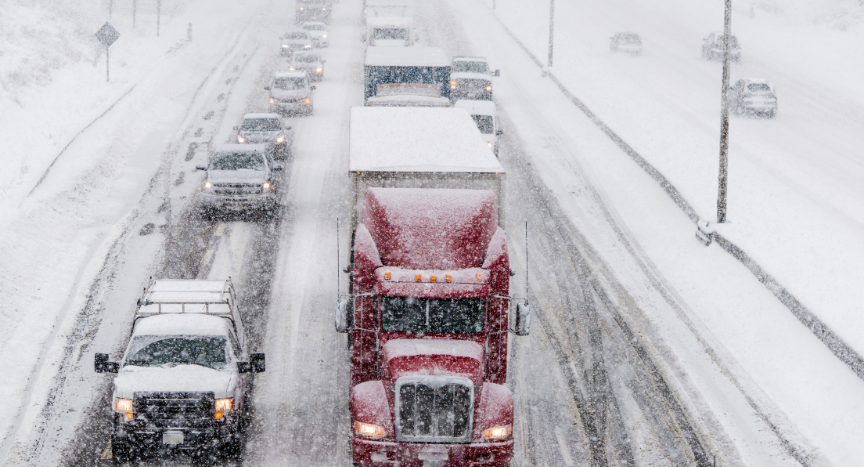
We asked the TruckDriversUSA community a simple question with a serious purpose: If you could tell rookie drivers one thing about winter driving, what would it be?
The answers came in fast and they were the kind of advice you only get from people who have lived it. Not theory. Not textbook talk. Just real reminders that can help you keep the truck shiny side up when the weather turns.
Below are the best winter driving takeaways from drivers in our community. We left out anything inappropriate, and we also skipped responses that were not useful for safety or professionalism.
What experienced drivers want rookies to remember first
A lot of responses boiled down to one message: do not let anyone rush you.
Jason Chilton put it plainly: “Don’t mind the Super Truckers flying by you doing 70 as if nothing’s wrong. They’ll be the ones getting pulled out of the ditch. Slow down, take it easy, and make sure that your load and more importantly you make it to your destination.”
That mindset showed up again and again. If conditions feel wrong, slowing down is not weakness. It is professional judgment.
Nick Longden backed that up with the decision making side of it: “You’re the driver . If it’s not safe to you, don’t let these people pressure you . It’s your license”
Barb Henderson kept it even simpler: “If it’s unsafe pull over No freight is worth your life or others”
And Tom Strizak echoed the same principle: “Don’t push it! No load is worth a life.”
Speed and space do more than horsepower ever will
Winter driving punishes impatience. The community hammered on two basics: slow down and leave room.
Kevin Williamson spelled out a practical target: “Slooooow down by 10-15+ mph. ARRIVE ALIVE”
Tammy Wudyker added the other half: “Slow down and don’t tailgate, pay attention to the road”
Mark Sibley said what every rookie needs to hear early: “QUIT TAILGATING!”
James Murphy focused on how to manage speed when traction is limited: “Learn to control your speed with you throttle not your brakes,keep your distance.know your limits.if you can’t keep all 18 in grip stop till you can.”
The point is not to crawl everywhere. It is to drive at a speed where the truck stays settled, your inputs stay smooth, and you have enough room to react without panic braking.
Make smooth moves and avoid sudden inputs
Several drivers warned rookies that winter is not the time for sharp corrections, abrupt throttle, or aggressive braking.
Michael Suan said: “Make no sudden moves. Take it at a pace you feel comfortable doing.”
Gisli E Stefansson broke down the physics in driver language: “Avoid G forces. Accelerate slowly, break slowly and corner slowly. Just relax. If you hit the brakes you are going sideways in a hurry.”
Carroll Pyles shared a classic mindset tip: “Drive like you don’t have any brakes”
That does not mean you never use brakes. It means you drive in a way that reduces how often you need them and how hard you have to apply them.
James Brusell put a specific warning on lockups: “Don’t lock up. You’re turning your truck into an uncontrolled tobbogon”
Cruise control and engine braking are frequent problem areas
Rookies love convenience. Winter weather does not.
Brian Bell said: “No cruise control and stay off your phone….”
Freddie Sturdivant gave a strong warning that many drivers learn the hard way: “Jake brakes and cruise control will cause you to wreck if the roads are slick”
You will also hear experienced drivers describe using engine braking carefully and smoothly rather than relying on service brakes. Shelley Bagley shared her approach: “Keep your foot off the brake unless you really need to use them.. Down shift and use the engine brake.”
The consistent takeaway for rookies is this: avoid anything that creates sudden changes in traction. If you use engine braking at all, keep it controlled, predictable, and matched to conditions.
Use your senses. The truck will tell you what the road is doing
Winter driving is not just about what you see. It is also about what you feel and hear.
Kevin Brown offered a tip many veterans swear by: “Turn off the music. You gotta listen to the engine tellin you to let off the fuel.”
Lorie Habel shared a similar habit stack: “Turn the c.b. low, listen to your engine, watch your mirrors”
Gary Smith talked about learning what the trailer is doing even before you see it: “Just slow down and try to relax. Driving by the seat of your pants is not just a saying. I’m not saying don’t look in your mirrors but with a little experience you can tell what the trailer is doing without seeing it”
And Floyd Gorsuch put the focus where it belongs: “Watch your side mirrors. Keep the trailer in a straight line behind you.. Remember your trailer weighs more that your tractor and it will run you over for the fun of it.”
Watch for early ice clues and protect your space
Ice is rarely announced. It shows up quietly and waits for you to make one bad input.
Mark Gottfried shared a practical sign many drivers use: “If ice on the backs of your mirrors, most likely ice on the road.”
He also added two situational reminders rookies often miss:
“Try not to allow vehicles to ride besides you.”
“Try not to let your trailer push you, especially across bridges.”
Dustin D’brew gave another quick check based on what traffic is doing: “If tires in front of you aren’t spraying….. slow down 10mph while loaded…. 15mph empty…. You’ll see why”
Tim Chetwynd gave a similar indicator and tied it to a clear decision point: “Also Watch For the spray from 4 wheelers because if you see spray were the tires hit the road you usually are ok but if you don’t see spray you could be on black ice. That’s when you park it.”
Chains are not a confidence badge. Know what they mean
Chaining up came up constantly, and a lot of experienced drivers offered the same warning: if it is bad enough for chain laws, it is often bad enough to slow way down or park until it improves.
Richard G Rice said: “Leave the chains on the truck. If it’s bad enough for the state to force you to hang iron on your tires, it’s bad enough to park, and wait for the roads to be cleared. It seldom takes more than 24 hours to clear the road.”
Josh Blevins shellenberger said: “If you have to wear chains then it’s better to just park until it’s clear enough NOT to wear chains. Less possible accident that way”
At the same time, preparation matters. Bill Hall gave the reminder that saves time and frustration when it is freezing and dark: “Make sure you learn how to put your chains on before you need them”
Pre trips matter more when it is miserable outside
Winter is when shortcuts get expensive.
Robert Saylors wrote: “Pretrips suck in the cold, almost as much as waiting roadside for parts does, check that rubber and the lines before you move stay alert stay alive”
Michael Gray gave a time-based reality check rookies can actually follow: “Take 10minutes to do a proper circle check before you start your run.”
Terrence Brown kept it straightforward: “Do your Pre Trip”
And Jeff Carruth called out one specific habit that prevents surprises when you stop on slick surfaces: “ALWAYS set your trailer parking brakes.”
Visibility tricks that drivers actually use
Winter driving is partly a visibility job. If you cannot see clearly, everything else gets harder.
Jason Hinds shared his windshield routine: “Keep your glass cold. Floor heat only, no defrost and crack windows about 1″”
Daniel Benes offered a similar tactic: “Open your windows and keep the heat off the windshield in a snow storm. It will keep it from icing the windshield”
These are personal techniques drivers use to manage fogging and icing. What matters most is that you find a method that keeps your glass clear and your mirrors usable.
Wind can turn a manageable storm into a serious threat
Rookies often focus only on snow and forget that wind can be the bigger problem.
Keith Morgan warned: “High winds are the most dangerous. They make mild snow storms more dangerous. And they can flip over trucks.”
If you are running open country, bridges, or mountain passes, wind is not background noise. It is a stability risk that can change quickly.
A final word for rookies from the community
Curtis Brennan summed up the job better than any slogan: “Its all about getting home not how fast you get there”
And Richard Williams brought it back to responsibility: “Drive like your life is dependent on it, For It Is and others around you.”
Winter is not the time to prove anything. It is the time to protect your space, manage your speed, and make decisions that keep you, your freight, and everyone around you safe.
If you are a veteran driver, we want to keep building this kind of knowledge base. If you could tell a rookie one thing about winter driving, what would it be? Join the conversation on the Truck Drivers USA Facebook page.