

A new study is putting hard numbers on a problem truck drivers know all too well: finding a safe and legal place to park. According to research commissioned by the Truck Parking Club and carried out by transportation economist Noel Perry, the nationwide parking shortage is costing drivers and the U.S. economy a staggering $100 billion every year.
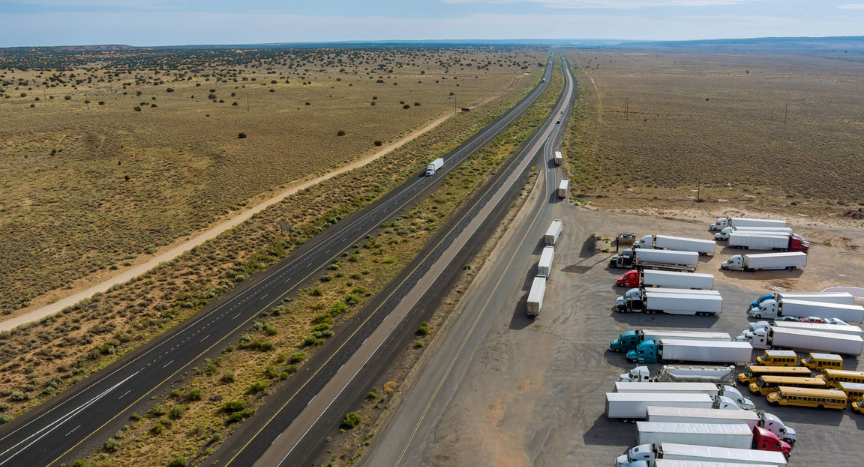
The report highlights the gap between what drivers need and what is actually available. Across the country, truckers require about 2.4 million parking spaces to meet rest requirements. Today, only 697,000 spots are accessible.
The study did find that 23.4 million heavy-duty truck spaces exist nationwide, but 98 percent of those are reserved privately for company fleets. That leaves the majority of drivers scrambling.
Perry explained how drivers are forced to adapt: truckers “make the best of a bad situation” by using “a combination of off-highway and informal on-highway spaces to get their required rest.” But those workarounds come with real costs.
“Fifteen miles of ‘circuity,’” Perry noted, “costs the driver $59 between the operating costs and lost time. If a driver stops an hour early to snag an available space, it costs them $110.”
The Bigger Picture
Beyond what it costs individual drivers, the shortage is draining the industry at scale. The study estimates $37.7 billion is lost each year from wasted miles while searching for parking. Another $82 billion is lost when drivers are stuck in the wrong place at the wrong time, unable to fully use their federally allowed driving hours.
Recommendations from the Study
The report doesn’t just size up the issue; it also lays out solutions that could ease the burden on drivers:
- Expand the number of dedicated truck parking areas, though this is costly and slow to implement.
- Open up legal parking opportunities at restaurants, retail lots, carriers’ yards, and shippers’ facilities.
- Provide truckers with real-time data on parking availability.
- Offer reservation systems for legal spaces.
- Encourage shippers and carriers to factor parking into their planning and scheduling.
- Coordinate supply chain timing to reduce unnecessary wait times.
While truck stop expansions and state investments, like Ohio’s recent plan to add 1,400 spaces, help, Perry’s findings show the problem is systemic and much larger than piecemeal fixes.
The full study can be downloaded here.
Source: Overdrive