
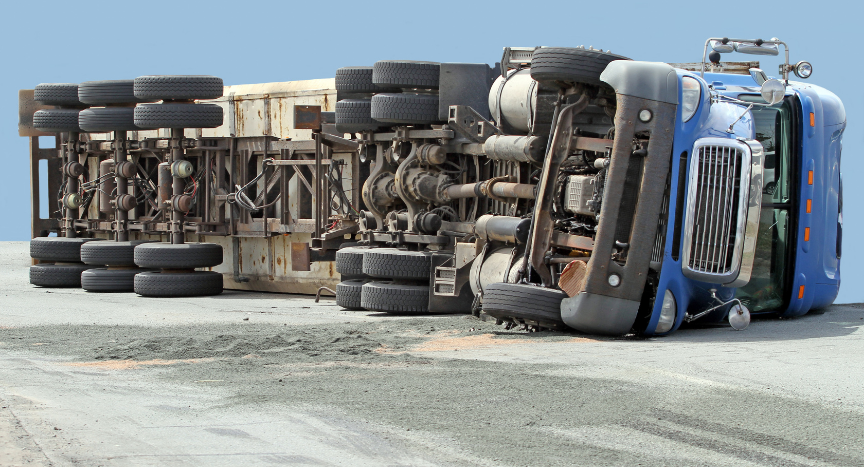
Truck rollovers are among the most severe crashes involving commercial vehicles, not only because of the damage they can cause, but because they often develop before the driver realizes the truck has reached its stability limit. By the time a trailer begins to lift, there is usually very little that can be done to reverse what has already happened.
Unlike a rear-end collision or a jackknife, a rollover is rarely tied to one decision. The combination of vehicle speed, road design, cargo placement, equipment condition and steering input determines how much stability a truck has at any given moment. Understanding how those factors work together is one of the most effective ways to reduce rollover risk.
Stability Changes Throughout the Trip
A tractor-trailer does not handle the same way on every load. Freight carried close to the trailer floor generally creates a lower center of gravity than freight stacked higher. The higher the center of gravity, the less lateral force is needed before the vehicle reaches its rollover threshold. That is why two loads with the same weight can behave very differently when entering the same curve.
Liquid cargo introduces another variable. Unlike palletized freight, liquid continues moving after the truck begins turning or braking. That movement shifts weight inside the tank and changes how the vehicle responds throughout the maneuver. Studies of cargo tank rollovers have shown that partially loaded tankers are involved in a significant share of rollover crashes because of this surge effect.
Many Rollovers Begin Before the Curve
One of the biggest misconceptions about rollovers is that they begin in the middle of a turn.
In reality, the sequence often starts much earlier. Carrying too much speed toward an interchange, delaying braking until after entering the curve, or making multiple steering corrections before the turn all reduce the amount of stability available once the truck changes direction.
Interchange ramps deserve particular attention because they combine tighter turning radii with changing elevation and shorter distances to reduce speed. Heavy-truck rollover studies have consistently identified ramps as locations where rollover risk is substantially higher than on most other roadway segments.
Small Steering Corrections Can Have Large Consequences
Drivers often associate rollovers with excessive speed, but abrupt steering inputs are another common factor.
A tire leaving the pavement, avoiding road debris, or reacting suddenly to traffic can shift thousands of pounds across the suspension in a fraction of a second. If the truck is already operating near its stability limit, that rapid weight transfer may be enough to start a rollover.
The objective is not simply avoiding sudden movements. It is recognizing situations early enough that sudden movements are unnecessary.
Equipment Condition Supports Vehicle Stability
Suspension components, tires, and brakes all influence how weight transfers across a tractor-trailer.
Uneven brake performance can change vehicle balance during deceleration, while worn suspension parts reduce the system’s ability to control body movement through curves. Tire condition also plays a role by affecting how consistently the truck responds to steering inputs.
These systems may not attract much attention during routine driving, but they become critical when the vehicle approaches its handling limits.
Technology Cannot Overcome Physics.
Modern tractors often include electronic stability control and roll stability systems that monitor steering angle, wheel speed, and lateral acceleration. When those systems detect conditions associated with a potential rollover, they can reduce engine power or selectively apply the brakes to help stabilize the vehicle.
Those systems are valuable, but they are designed to assist the driver rather than replace good driving habits. They cannot compensate for excessive speed entering a curve or a load that has already shifted beyond the vehicle’s stability limits.
Building Better Habits Behind the Wheel
Rollover prevention starts well before a truck reaches an exit ramp. Knowing how freight has been loaded, reducing speed before entering curves, looking farther ahead in traffic and keeping suspension, brake and tire components in good condition all contribute to vehicle stability. None of those decisions guarantees a rollover will never occur, but together they provide the driver with more margin when road or traffic conditions change unexpectedly.
Most rollover crashes develop through a series of small events rather than one dramatic mistake. Recognizing those events early gives drivers the best opportunity to keep the truck stable and continue the trip safely.
Frequently Asked Questions
What causes most truck rollovers?
Most truck rollovers involve a combination of factors rather than a single cause. Speed entering curves, cargo placement, abrupt steering inputs, vehicle condition, and road geometry all influence stability.
Why are tanker trailers more susceptible to rollovers?
Liquid cargo continues moving during turns and braking, changing the trailer’s center of gravity throughout the maneuver. That movement makes tanker combinations more sensitive to weight transfer than trailers carrying solid freight.
Do truck rollovers only happen on curves?
No. While curves and ramps are common locations, some rollovers begin after drivers overcorrect when recovering from a tire leaving the pavement or making an emergency steering maneuver.
Can electronic stability control prevent every rollover?
No. Stability systems can reduce rollover risk, but they cannot overcome excessive speed, poor load distribution or severe steering inputs.
How can drivers reduce rollover risk?
Maintaining appropriate speed, understanding how cargo affects vehicle handling, avoiding abrupt steering corrections, and keeping the truck in good mechanical condition all help preserve vehicle stability.