
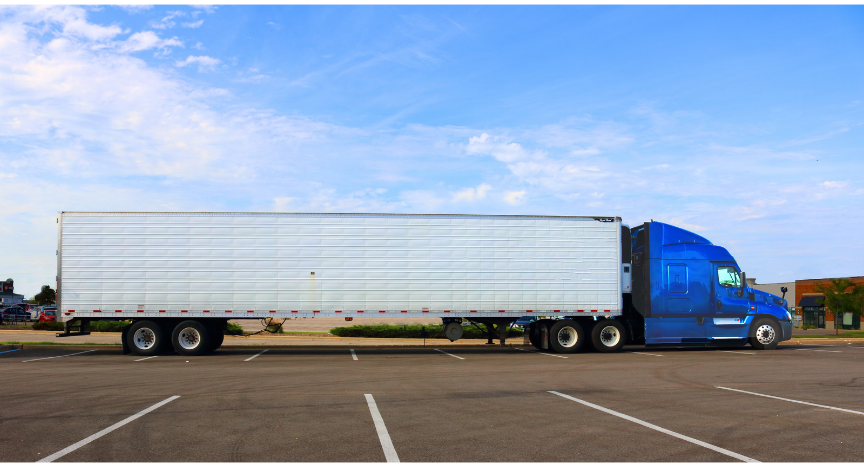
In 1899, Cleveland automaker Alexander Winton developed a vehicle hauler that could transport one finished automobile to a customer without adding mileage to the car. More than a century later, specialized trailers are carrying wind turbine blades hundreds of feet long, electrical transformers weighing hundreds of thousands of pounds and industrial machinery that cannot fit on conventional equipment.
The designs used for these shipments developed over decades as the demands of American manufacturing, construction and transportation changed. Automobile carriers increased in capacity, lowboy trailers made larger machinery easier to move, and new suspension and steering systems expanded the possibilities for heavy hauling. Each advancement addressed a limitation that earlier equipment could not overcome.
Automobile Transporters and the Origins of Specialized Trailers
One of trucking’s earliest specialized designs emerged from a problem facing the automobile industry. In the late 1890s, Alexander Winton was manufacturing automobiles in Cleveland, Ohio, but delivering them to customers outside the region was difficult. Driving each vehicle to its destination added wear, accumulated mileage and required arrangements for the delivery driver to return.
Winton developed a hauling system that used a modified motor vehicle to pull a small semi-trailer carrying another automobile. By 1899, the Winton Motor Carriage Company was manufacturing these haulers for its own deliveries and other automobile producers. The design became an important early example of the semi-trailer concept.
As automobile production expanded during the twentieth century, transporting vehicles individually became increasingly impractical. Carriers needed to move several automobiles at once while keeping them secure and within roadway height and length restrictions. Trailer manufacturers responded with longer platforms, multiple loading levels and adjustable ramps.
The development of multi-level automobile transporters increased carrying capacity without requiring a separate trip for every vehicle. Later designs incorporated hydraulic decks that could be raised, lowered or repositioned to accommodate different combinations of passenger cars, pickups and larger vehicles.
Modern car haulers still use these principles, although their construction and loading systems are considerably more sophisticated. The industry’s early transportation problem ultimately helped establish a trailer configuration that remains essential to automobile distribution.
Lowboy Trailers and the Development of Removable Goosenecks
Construction equipment presented different transportation problems as machinery became larger during the twentieth century. Bulldozers, excavators and other heavy machines could be difficult to load onto conventional flatbeds, while their height sometimes made transportation impractical without reducing the distance between the equipment and the roadway.
Lowboy trailers addressed the clearance problem through a lowered deck positioned between the trailer’s front connection and rear axles. By carrying machinery closer to the ground, these trailers provided additional overhead clearance compared with a conventional flatbed.
The lower deck improved transportation, but loading remained difficult. Fixed-neck lowboys generally required equipment to approach from the rear, often using ramps that could be challenging for heavy machines or those with limited ground clearance.
Removable goosenecks offered another approach. By disconnecting the front section of the trailer, operators could lower the deck to create a loading path from ground level. Self-propelled machinery could then be driven onto the trailer before the gooseneck was reattached.
American trailer manufacturer Talbert played a significant role in refining these systems. The company’s founder, Austin G. Talbert, received a patent in November 1965 for a detachable gooseneck assembly designed to engage and lift the front of a lowbed trailer. Earlier removable-gooseneck designs had already been patented, making Talbert’s work part of a broader period of development rather than the invention of the concept itself.
Hydraulic removable goosenecks further improved the loading process by allowing operators to raise and lower the trailer’s front section using hydraulic mechanisms. This reduced the need for separate lifting equipment and made the connection process more manageable.
These trailers remain widely used in construction, agriculture and heavy-equipment transportation. Their combination of low deck height and front-loading access makes them particularly suitable for machinery that would be difficult to load onto an elevated platform.
Extendable Trailers Accommodated Longer Industrial Freight
While lowboy trailers addressed the height of heavy machinery, other industries required equipment capable of supporting unusually long loads. Steel beams, bridge sections, utility poles and industrial structures could exceed the length of conventional trailers even when their weight remained within manageable limits.
Extendable trailers were developed to accommodate these shipments through telescoping frame sections. The trailer could be lengthened to support the cargo and shortened after delivery, allowing the same equipment to handle different load dimensions.
As manufacturing and infrastructure projects expanded, longer structural components increased demand for these configurations. However, the growth of wind energy introduced particularly difficult transportation requirements.
Modern wind turbine blades can extend well beyond 200 feet, requiring specialized equipment to support their length and negotiate the roads leading to installation sites. A trailer capable of carrying such a blade on a straight highway may still encounter serious maneuverability problems at intersections, curves or construction entrances.
Manufacturers responded by combining telescoping frames with specialized steering systems. Trail King’s EFX blade hauler, for example, uses a double-telescoping design and hydraulic steering to accommodate long turbine components. Certain configurations can extend to approximately 173 feet, including the pull-out section.
The development of these trailers also required changes in how loads were supported. Unlike a rigid steel beam, a turbine blade has specific structural characteristics and designated support locations. Trailer configurations must account for these requirements while controlling overhang and the forces experienced during transportation.
Consequently, modern extendable trailers are engineered around both the dimensions of the shipment and the route it must travel. Steering arrangements, support positions and the ability to shorten the equipment between assignments have become important features of these designs.
Multi-Axle Trailers Expanded Heavy-Haul Capabilities
Increasing the length or lowering the deck of a trailer does little to address the challenges created by exceptionally heavy freight. Large electrical transformers, generators and industrial machinery can exceed the practical carrying capacity of conventional axle arrangements, requiring specialized systems to distribute their weight.
Heavy-haul trailer development increasingly focused on axle spacing, suspension performance and the relationship between the tractor, trailer and cargo. Adding axles could spread weight across more contact points, but the arrangement also had to account for how the load transferred between them.
Hydraulic suspension became an important advancement because it allowed connected axle groups to share weight while accommodating changes in road elevation. This helped prevent individual axles from carrying excessive loads when the equipment traveled across uneven surfaces.
Modular trailer systems expanded these capabilities by allowing transporters to connect multiple axle units into configurations suited to individual shipments. Depending on the cargo, modules could be arranged lengthwise or side by side to provide additional support and stability.
The growth of modular transportation also increased the importance of steering technology. Extremely long combinations with numerous fixed axles would experience considerable tire scrubbing and require substantial turning space. Steerable axle groups helped address these problems by allowing the wheels to follow more suitable paths through curves.
Modern heavy-haul operations use these configurations to transport equipment that would otherwise be difficult or impossible to move on conventional trailers. However, the number of axles alone does not determine whether a shipment can travel legally over a particular route. Bridge capacities, axle-group spacing, roadway restrictions and permit conditions must all be considered.
Perimeter-Frame and Schnabel Trailers for Exceptional Loads
Some industrial components are too tall or heavy for conventional deck arrangements, even when transported on lowboy or multi-axle equipment. In these cases, manufacturers developed trailers that support freight differently rather than simply modifying the dimensions of a traditional platform.
Perimeter-frame trailers use structural beams positioned along the sides of the load, allowing equipment to occupy a lower central area. This arrangement can reduce the overall loaded height compared with placing the same cargo on top of a continuous deck.
Certain perimeter-frame designs also incorporate adjustable widths to accommodate unusually large machinery. Trail King manufactures expanding-frame configurations that can adjust from approximately 12 to 20 feet in width, providing additional flexibility for specialized industrial shipments.
Schnabel trailers take a different approach by attaching directly to designated structural points on the cargo. Instead of resting on a continuous trailer deck, the load is suspended between front and rear transport assemblies.
These systems are particularly associated with transporting large electrical transformers. Eliminating the conventional deck beneath the equipment can reduce transportation height, while multiple axle groups distribute the weight across the vehicle combination.
Because the cargo becomes part of the carrying structure, the attachment points and supporting assemblies must be engineered for the specific shipment. The arrangement requires detailed coordination between equipment manufacturers, transportation specialists and the company responsible for the load.
Both designs expanded the range of industrial equipment that could be transported by highway, particularly where conventional trailer platforms created clearance or support limitations.
Wind Turbine Blade Carriers Introduced Adjustable Load Positioning
The continued development of wind energy has led to specialized equipment that can change the position of the freight during transportation.
Although extendable trailers can accommodate extremely long blades, certain routes present obstacles that cannot be addressed through trailer length alone. Tight curves, steep grades, overhead restrictions and narrow access roads can make it difficult to transport a blade in a fixed horizontal position.
Blade-lifting systems provide another option by allowing the cargo to be raised and rotated while secured to the transport equipment. These systems are designed for routes where adjusting the blade’s orientation can help negotiate particular obstacles.
Goldhofer’s FTV 1150, for example, can raise a turbine blade to an angle of up to 60 degrees and rotate its position. The equipment incorporates specialized support mechanisms to manage the forces acting on the blade during these movements.
Other configurations use a trailing dolly rather than a continuous trailer frame. The blade is supported at designated points between the front and rear transport assemblies, allowing the combination to negotiate certain restricted routes with greater flexibility.
These systems introduce their own operating requirements. Wind exposure, cargo stability, ground clearance and the structural limitations of the blade must be evaluated before and during transportation. Raising a blade can improve clearance in some circumstances while increasing sensitivity to wind and other environmental conditions.
Their development represents an important advancement in specialized hauling because the equipment can adjust the orientation of the cargo rather than relying entirely on a fixed carrying position.
How Specialized Trailer Design Continues to Develop
The development of specialized trailers has followed changes in the industries that depend on them. Automobile manufacturing encouraged the introduction of dedicated vehicle carriers, while construction equipment led to lower decks and improved loading systems. Longer industrial components increased demand for telescoping frames, and exceptionally heavy machinery required more sophisticated axle and suspension configurations.
Many modern trailers combine technologies that were originally developed to solve separate problems. Hydraulic systems control suspension, steering and loading functions, while modular equipment allows transporters to assemble configurations suited to particular shipments.
These advancements have made it possible to move increasingly large and complex freight over American highways. The equipment continues to evolve as manufacturers introduce machinery, infrastructure components and energy systems that place new demands on transportation.
Frequently Asked Questions
Why do some heavy-haul combinations use jeep dollies and boosters?
Jeep dollies and boosters provide additional axle capacity to help distribute weight across a larger portion of the vehicle combination. A jeep is generally positioned between the tractor and trailer, while a booster is connected behind the main trailer. Their effectiveness depends on the configuration, axle spacing and suspension system, and additional axles do not automatically make an overweight load legal.
What is the difference between a hydraulic removable gooseneck and a mechanical removable gooseneck?
Both designs allow the front of a lowboy trailer to be disconnected for loading. A hydraulic removable gooseneck uses hydraulic power to assist with raising, lowering and reconnecting the trailer, while mechanical versions rely on different coupling and lifting arrangements. The appropriate configuration depends on equipment requirements, operating conditions and the trailer’s design.
Why do some specialized trailers have steerable rear axles?
Steerable rear axles improve maneuverability by allowing the wheels to follow a more suitable path during turns. They can reduce tire scrubbing and help long combinations negotiate restricted routes. Depending on the equipment, steering may operate automatically through mechanical or hydraulic systems or allow additional control during difficult maneuvers.
How are modular heavy-haul trailers transported between assignments?
Many modular systems can be separated into individual axle units or smaller assemblies for transportation. The components are moved to the next location and connected in the configuration required for the shipment. Depending on their dimensions and weight, some components may still require specialized transportation or permits.
Do specialized trailers require different permits than conventional tractor-trailers?
Permit requirements depend on the dimensions and weight of the loaded combination, the route and the jurisdictions involved. Oversized or overweight shipments may require state-issued permits specifying travel restrictions, approved routes, escort vehicles and other conditions. A specialized trailer does not automatically require an oversize permit when operating within applicable limits.
Can specialized trailers transport ordinary freight?
Some specialized trailers can accommodate conventional freight when the cargo is compatible with their structure and carrying capacity. However, their additional weight, operating requirements and configuration may make them less practical than standard equipment. Highly specialized designs, such as Schnabel trailers and dedicated turbine blade carriers, are intended for particular types of cargo and generally have limited applications outside those purposes.
The TDUSA editorial team creates practical, driver-focused content covering trucking news, industry updates, safety, regulations and career information for professional truck drivers across the United States. Each article is built to reflect real-world experience, industry developments and information drivers can use on and off the road.
Last Updated: October 12, 2026