
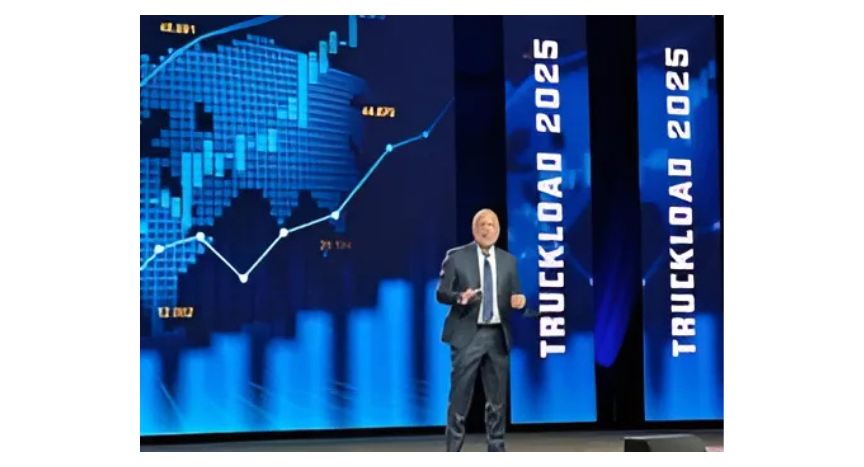
Tariffs remain a hot topic and are causing concern across industries. A leading trucking economist described the issue as a “very fluid situation,” and it took center stage at this year’s Truckload Carriers Association (TCA) annual convention in Phoenix.
Bob Costello, Chief Economist and Senior VP of International Trade and Security Policy at the American Trucking Associations (ATA), delivered his 2025 Economic Industry Review. He outlined how these proposed tariffs would affect the trucking sector, from increased equipment costs to significant changes in freight patterns.
Tariffs and Their Ripple Effect
One of the proposed tariffs’ most surprising impacts is how they may alter freight patterns. Costello touched on the potential fees suggested by the U.S. Trade Representative’s office, which include up to $1 million per port call for Chinese vessel operators and $1.5 million for shipping companies using Chinese-built vessels.
Costello explained, “It absolutely could change freight patterns. I think it’s a really big deal.” Such high charges could discourage shipping lines from making multiple port calls, potentially consolidating their stops. “What they’re probably going to do is dump all of the cargo in one port and move on,” Costello noted.
This shift impacts not only imports but also export activities along the East Coast. Smaller ports that play a vital role in local industries may suffer. For instance, factories in Alabama rely on the Port of Mobile for exports. “There’s a good chance a lot of these ocean carriers are not even going to make that call and not go to Mobile anymore,” he added.
Consumer Behavior Drives Freight Patterns
Costello predicted a gradual return to standard freight patterns in 2025, following consumer-driven spending habits that delayed economic recovery. He warned, however, that implementing additional tariffs could trigger another economic downturn.
The proposed tariffs include an additional 10% on goods from China, 25% on steel and aluminum, and 25% on Canadian and Mexican imports. The latter is particularly concerning for the trucking sector as it directly affects the costs of tractors and trailers.
“If it in fact goes through … for any substantial amount of time, I think that brings in a real risk of macro recession, no doubt about it,” Costello stated. He emphasized that tariffs function as taxes, and price increases on goods will ultimately lead to consumers purchasing fewer items, dragging down freight volumes.
This follows the trend during the pandemic-fueled freight recession, where spending on goods skyrocketed due to limited entertainment and travel options. “We all remember; it was not fun. So, what did people start doing during that period? They just started buying stuff,” Costello recalled. Terms like “revenge travel” became popular as consumers shifted their focus from goods to experiences, attending concerts, or taking multiple vacations.
Now, with consumer spending normalizing and the economy showing signs of stabilization, the trucking industry faces an adjustment period.
Market Stabilization and Economic Outlook
Despite some turbulence, positive trends are on the horizon for the freight sector. Costello projects a 3.3% increase in goods spending and a 2.2% rise in spending on experiences this year. Notably, inflation for goods is currently lower than for services, encouraging higher spending on physical products.
Additionally, factory output, which declined by 0.4% in 2023 and 2024, is expected to rebound with a growth of 1.3% in 2025 and 2.5% in 2026. Although some subsectors may see slower recovery, overall manufacturing activity is anticipated to drive freight demand upwards.
The housing market also shows promise. Costello forecasted consistent growth in existing home sales, prompting an uptick in expenditures for home improvements. Meanwhile, new housing starts, estimated at one million, are likely to generate substantial freight opportunities.
“It wasn’t like the boom of the pandemic, but it’s certainly much better, and I think that is absolutely going to help,” Costello concluded.
Source: Commercial Carrier Journal
Image Source: Angel Coker Jones