
Every tractor-trailer has blind spots, but they are not fixed areas that stay the same from one mile to the next. They change with traffic, road position, trailer length, and even the way a driver’s mirrors are adjusted. A passenger vehicle that was visible a few seconds ago can disappear without changing lanes, making blind-spot awareness less about finding a vehicle and more about keeping track of where it has moved.
The trucking industry often refers to these hidden areas as “No-Zones” because they limit what a driver can see through direct vision and mirrors. While modern mirror systems and camera technology have improved visibility, neither removes the need to build a continuous picture of the traffic surrounding the truck.
Visibility Starts Before the Truck Leaves the Yard
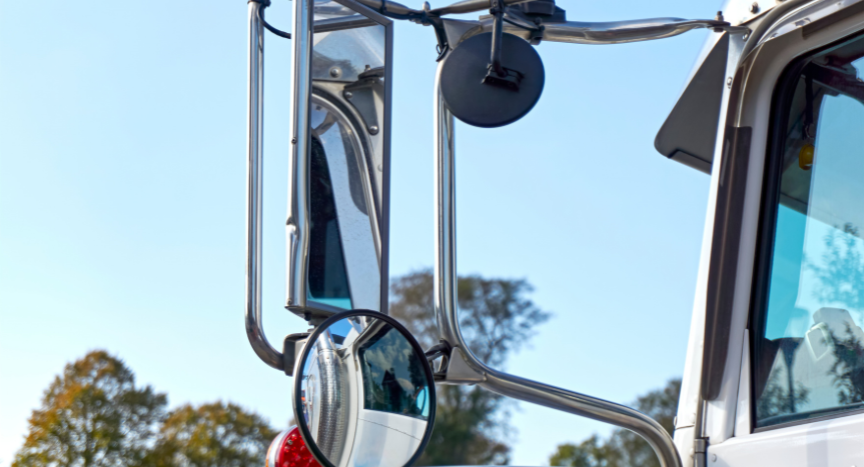
Blind-spot management begins with equipment that is properly adjusted. Flat mirrors provide the clearest sense of distance, while convex mirrors widen the driver’s field of view by covering areas that would otherwise remain hidden. The tradeoff is that convex mirrors make vehicles appear smaller and farther away, which is why both mirror types are designed to work together rather than independently. Research evaluating commercial truck mirror systems found that properly positioned convex mirrors significantly reduce hidden areas compared with flat mirrors alone.
A mirror that has been bumped during fueling, maintenance, or a trailer swap can quietly reduce visibility without being obvious from the driver’s seat. Taking a few moments to verify mirror position before leaving can prevent much larger problems later in the trip.
The Passenger Side Demands the Most Attention
The widest blind area usually extends along the passenger side of the tractor and trailer. Unlike the driver’s side, where direct vision supplements the mirrors, nearly everything on the right side depends on what the mirrors reveal. A vehicle traveling at nearly the same speed as the truck can remain beside the trailer while moving between mirror views, making it seem to disappear even though it has never left the lane.
That is one reason experienced drivers rarely make a lane change based on a single mirror check. Instead, they continuously monitor surrounding traffic so they already know which vehicles are likely to be beside the truck before beginning the maneuver.
The Blind Spots Change When the Truck Turns
A right turn creates a different visibility challenge than a lane change. As the tractor begins turning, the trailer follows a tighter path and the mirror angles change throughout the maneuver. A cyclist, pedestrian, or passenger vehicle that was visible moments earlier may no longer appear in the same mirror as the combination vehicle pivots through the intersection.
Wide right turns require constant observation because the area alongside the trailer changes throughout the turn instead of remaining fixed. That is why slowing the maneuver often provides more benefit than rushing to complete it.
The Area Behind the Trailer Can Hide More Than You Think
Most passenger vehicles assume they are visible if they are directly behind a truck, but that is not always the case.
Unlike a passenger car, a tractor-trailer has no rear window. Visibility depends entirely on the side mirrors, and a vehicle following closely behind the trailer may disappear until it moves farther back or changes position.
This becomes especially important in stop-and-go traffic, where vehicles frequently move into and out of that rear blind area without the truck changing speed or direction.
Blind Spots Are Managed with Traffic Awareness
Mirror checks are most effective when they happen throughout the trip rather than only before a lane change.
Commercial drivers are taught to scan mirrors regularly while watching traffic well ahead of the truck. That habit makes it easier to recognize when a nearby vehicle has moved into a position that is no longer visible. Research into large-truck crashes has also identified inadequate surveillance as one of the contributing factors in a significant number of collisions, reinforcing the importance of continuous observation rather than last-second decisions.
Knowing where surrounding vehicles were a few seconds ago often provides more useful information than trying to locate them after they have already disappeared from view.
Cameras Add Visibility but Not Certainty
Many newer commercial trucks are equipped with camera-monitor systems, additional convex mirrors and blind-spot detection technology.
These systems can expand the driver’s field of view and improve visibility during lane changes and merges, particularly on the passenger side. They still have limitations, however. Rain, road spray, glare, dirty lenses, and equipment malfunctions can reduce image quality, making it important to continue using mirrors and visual scanning instead of relying on a single display.
Technology can provide another layer of information, but the driver’s awareness remains the foundation of safe operation.
Frequently Asked Questions
Where is the largest blind spot on a semi-truck?
The passenger side generally has the largest blind area because the driver relies almost entirely on mirrors to monitor traffic on that side of the vehicle.
Do mirror adjustments affect blind spots?
Yes. Mirrors that are incorrectly positioned can create larger hidden areas or reduce overlap between flat and convex mirrors, making surrounding traffic harder to track.
Why are right turns challenging in a tractor-trailer?
The trailer follows a tighter path than the tractor, causing the driver’s field of view to change throughout the turn. Vehicles, cyclists, or pedestrians beside the trailer can move into areas that are difficult to monitor if the turn is rushed.
Can camera systems eliminate blind spots?
No. Camera-monitor systems improve visibility, but they can still be affected by weather, dirt and equipment limitations. They are designed to supplement mirror use rather than replace it.
How often should commercial drivers scan their mirrors?
Regular mirror scanning helps drivers maintain awareness of surrounding traffic instead of reacting only when preparing to change lanes or merge. Continuous observation is a core defensive driving practice taught throughout the commercial driving industry.
Why do vehicles seem to disappear beside a trailer?
When two vehicles travel at similar speeds, a passenger vehicle can move between different mirror views while remaining alongside the truck. Without continuous scanning, it can appear to vanish even though it has stayed in the same lane.