

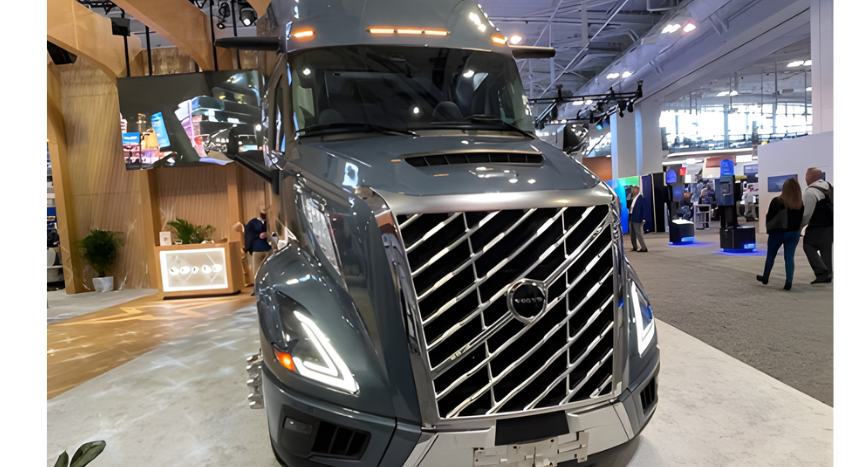
Volvo Trucks North America used its time at the Technology & Maintenance Council meeting to talk about where its trucks are headed next. Alongside updates on new models, software, and factory investments, one message stood out for drivers and fleet operators: a new VNX heavy-haul truck is on the way.
A New VNX Is Coming
Volvo confirmed that a next-generation VNX is expected to debut later this year. While details are still limited, the move points to a bigger plan already underway across the company’s lineup.
The current VNX is built for heavy-haul and severe-duty work. It has not yet been updated with Volvo’s latest platform, which has already been rolled out in the newer VNL and VNR models. Bringing the VNX into that same system would give heavy-haul operators access to the same fuel savings, safety upgrades, and connected tech.
“We’re in the midst of more than $2 billion in product investments,” said Magnus Koeck, vice president of strategy, marketing, and brand management. “And we’re not done.”
For fleets running specialized freight, this signals that Volvo is getting more serious about competing in heavy-haul and vocational segments.
What the New Platform Is Delivering So Far
Volvo’s latest truck platform first showed up in the redesigned VNL, followed by the VNR for regional operations. Early numbers are already getting attention across the industry.
The VNL is delivering fuel economy gains of 10 percent or more in real-world use. The VNR is targeting up to 7.5 percent fuel savings. For carriers watching every cost, those numbers matter.
“In today’s environment, that can mean a 3% improvement in operating margin,” Koeck said. “That’s the difference between profit and loss for many fleets.”
For owner-operators and fleet managers alike, that kind of margin shift can decide whether a truck stays profitable over time.
Expanding Production to Keep Up
To support these new trucks, Volvo is putting serious money into production. The company has invested more than $400 million into its New River Valley plant in Virginia and is building a new $700 million facility in Monterrey, Mexico.
The Mexico plant is expected to begin low-volume production later this year. Volvo has made it clear this is about adding capacity, not replacing U.S. manufacturing, as it looks to grow its footprint in North America.
Trucks Are Getting More Connected
Volvo is also pushing further into connected truck technology. More than 220,000 Volvo trucks across North America are now connected, allowing over-the-air updates that can be installed without taking trucks off the road.
Adoption has picked up quickly. In about six months, the number of trucks running the latest software jumped from roughly 25 percent to more than 80 percent. According to Volvo, trucks with updated software are seeing 24 percent fewer unplanned stops.
“Trucks today are essentially smartphones on wheels,” said product expert Maddie Sullivan. “They’re constantly improving.”
For drivers, that means fewer shop visits tied to software issues and more updates happening without downtime.
New Hardware to Support More Data
Volvo is also working on a new tractor-trailer connector designed to handle more data than current systems. Today’s connectors mainly support lights and braking, but newer trucks rely on cameras, sensors, and telematics that need more bandwidth.
The company says it is working with partners to turn this into a new standard across North America. If adopted widely, it could improve how tractors and trailers share information in real time.
Safety Features Continue to Expand
Safety remains a major focus across Volvo’s lineup. New platform trucks now include features like a side-curtain airbag for heavy-duty applications and an automatic emergency call system that alerts first responders after a crash.
Additional options include blind-spot detection along the full length of a 53-foot trailer, adaptive lighting, and Volvo Dynamic Steering.
Beyond safety itself, there is also a financial side. Volvo noted that even non-injury crashes can average close to $50,000 in damage, making prevention a priority for fleets trying to control costs.
What This Means for Drivers and Fleets
Between a new VNX on the horizon, ongoing platform upgrades, and continued investment in both hardware and software, Volvo is clearly building toward a more unified lineup.
For drivers, that likely means more consistency from truck to truck. For fleets, it points to better efficiency, fewer unexpected repairs, and more control over operating costs.
With the heavy-haul segment next in line, the upcoming VNX will be one to watch as more details come out later this year.