
The Federal Motor Carrier Safety Administration (FMCSA) has rolled out updated guidance on enforcing the English proficiency requirement for commercial drivers, alongside a review of non-domiciled CDL licenses often held by foreign nationals. Effective immediately, this policy provides clearer enforcement steps for ensuring compliance with 49 CFR § 391.11(b)(2).
This update coincides with the Department of Transportation’s decision to phase out prior leniencies around English language proficiency introduced during the Obama administration.
Two-Step Evaluation Process for ELP Compliance
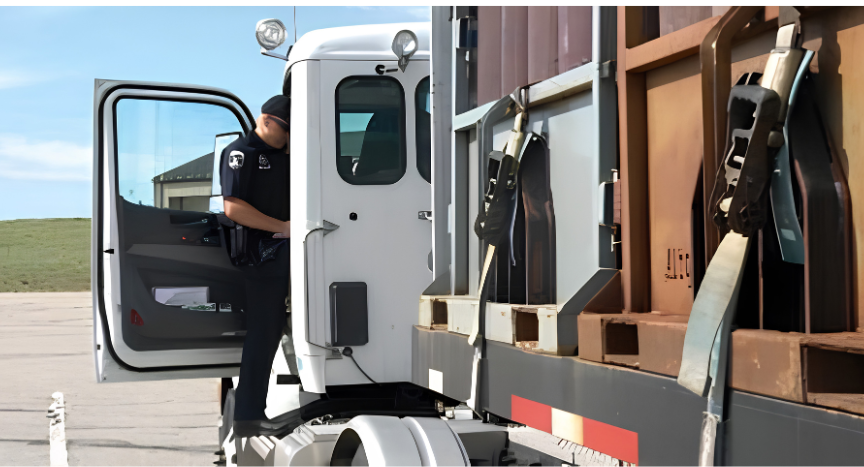
The FMCSA’s new enforcement framework involves a two-step process comprising a driver interview and a highway traffic sign recognition assessment. All roadside inspections will begin in English to assess compliance with the rule. This structured approach enables inspectors to uphold the regulation systematically.
Driver Interview
The first step assesses whether the driver can “respond to official inquiries by speaking English sufficiently.” During this interview, the FMCSA mandates that interactions must take place solely in English. Tools like interpreters, cue cards, or translation apps cannot be used as they may conceal deficiencies in English communication abilities.
FMCSA clarifies if the driver is unable to respond sufficiently in English, inspectors are instructed to issue a violation under 49 CFR § 391.11(b)(2). Drivers who fail the interview do not proceed to the second evaluation phase.
Highway Traffic Sign Recognition
If the driver passes the interview, the next step evaluates their ability to read and comprehend U.S. highway traffic signs in accordance with the Manual on Uniform Traffic Control Devices (MUTCD). The assessment ensures that commercial drivers understand key road signage, including dynamic message boards encountered during operations.
Enforcement Actions and Penalties
If violations of the English language proficiency regulation are identified, inspectors must document all supporting evidence, including responses or a lack thereof. FMCSA policy also requires follow-up actions, such as placing non-compliant drivers out of service (OOS) and initiating potential disqualification from operating commercial motor vehicles in interstate commerce.
The Commercial Vehicle Safety Alliance (CVSA) has already incorporated ELP non-compliance into its North American Standard Out-of-Service Criteria, effective June 25. FMCSA guidance directs inspectors to inform out-of-service drivers that operating a commercial motor vehicle while under OOS conditions is strictly prohibited until compliance is restored.
However, FMCSA notes that drivers operating within U.S.-Mexico border commercial zones may be cited for violations but will not face OOS placement or disqualification.
Exemptions for Hearing Impairments
Per FMCSA’s guidance, hearing-impaired drivers with an exemption under 49 CFR § 391.41(b)(11) are protected from disqualification under 49 CFR § 391.11(b)(2). These drivers are not required to meet verbal English communication standards.
Enhancing Safety Through Stronger Compliance
With the introduction of the two-step evaluation, FMCSA aims to ensure that commercial drivers possess adequate English-speaking skills and can interpret critical road signage, bolstering safety throughout U.S. highways.
For more updates on FMCSA regulations and compliance standards, stay connected to industry news.
Source: Commercial Carrier Journal
- bilingual drivers
- CDL compliance
- CDL enforcement
- CDL violations
- commercial driver interview
- commercial drivers
- commercial motor vehicle rules
- CVSA
- DOT updates
- ELP requirement
- English proficiency
- FMCSA
- FMCSA guidance
- highway safety
- non-domiciled CDL
- out-of-service criteria
- traffic sign test
- truck driver regulations
- trucking regulations
- U.S. trucking laws